Showing posts with label factory farming. Show all posts

Friday, September 30, 2011

Progressive Dairyman: Dairy Blogs We Love

I am honored that my blog is featured on Progressive Dairyman Magazine's "Dairy Blogs We Love" list! Progressive Dairyman is one of my favorite agricultural publications and their "Proud to Dairy" campaign is fabulous!

I'm not offically a dairy farmer, although I am a passionate advocate for dairy and on our farm here in North Dakota we partner with a local dairy farm to graze dairy heifers on our cover crops and my family raises dairy heifers in Maryland.

If you'd like to see the complete list of "Dairy Blogs We Love", check it out here:

http://proudtodairy.ning.com/page/dairy-blogs-we-love

Oh, and one more thing... someday, somehow, I WILL have dairy cattle again (like this adorable little gal I met in Germany). Mark my words :)

Monday, August 22, 2011

A Hunger For Faith-Based Ag Education


A vacation bible school student greets a calf at Entzminger Dairy, Jamestown, ND, as part of a lesson on "creation".


This time last year, I wrote this guest blog post for a dear friend and an "agvocate" I admire greatly, Michele Payn-Knoper at Cause Matters Corp. , about the concept of faith-based agriculture education. THANKS Michele for this opportunity!


Thought you all might be interested in seeing it since it's back to school time and as a farm wife and mother of a pre-kindergarten student, I'm thinking of what is being said about agriculture in the classroom and what I can do to help tell the story of agriculture both in and out of the classroom...

A Hunger For Faith-Based Ag Education

Enjoy!
Sarah :)

Wednesday, August 10, 2011

Early 1900's Kansas Wheat Harvest

Last April I spent two solid days with my husband Jeremy's Grandpa "Bill" Wilson at his kitchen table scanning farm and family photos and recording Grandpa's comments about them. They were two of the best days of my life!
Grandpa turned 90 this past November and he is still as sharp as a tack and VERY funny! The vivid memories of his youth are simply amazing and very humbling.
I am so grateful to Grandpa for sharing his time and memories with me and for showing me his precious photos and artifacts. I also have to say THANK YOU to his long-time girlfriend, Lorraine, (aka Grandma Bair), for watching my girls as Grandpa and I completed our task. C.W. and the wee red head were a very busy 3 and 1 then :)
I thought I would share some of the fruits of our labor with you. I hope you enjoy this little journey into the past to look at wheat harvests of the early 1900's. The Wilson family farmed in Kansas before they moved to North Dakota, so what you see are pics from the Salina, Kansas and Cambria, Kansas areas.
This is Jeremy's Great-grandfather, J. Harry Wilson:
Below, a threshing crew. FYI- Threshers separate the grains of wheat from the straw (stem) and chaff (the rest of the plant that surrounded the grain).
Below, Grandpa Wilson's brother-in-law, John Lang, with two of the mules who likely helped with harvest.
Below, Jeremy's Great-grandfather, J. Harry Wilson, ran this threshing crew in Salina, Kansas, 1905.
Here J. Harry Wilson's crew takes a break for a meal. He is seated on the left and is wearing suspenders. Grandpa didn't know who the rest of the folks were, but we agreed that the women standing in the back had a pretty big job on their hands cooking for that bunch!
This is a photo of the Lang and Wilson families. J. Harry Wilson and his wife, Susan (Jenkins) Wilson, my husband's great-grandparents, are standing in the back row on the right.
The pictures you've just seen were taken in Kansas, but Grandpa Wilson said that when his family settled on the farm we're on now in the early 1930's, his mother, Susan, would haul a load of wheat each year to a mill in Valley City (about 35 miles east of Jamestown) and have it ground into flour. The flour was put into 50 lb. bags and she would use 52 bags a year to feed his family and all the men who worked on the farm. Now THAT is some serious baking!
Time marches on and wheat harvest is upon us once again. Looks like we'll get started today if all goes well and this good weather holds.
These are the combines our family used to use:
And here is the one we use today:
We've come a long way since the early 1900's!
I hope that those who read this take a moment to consider the generations of knowledge and hard work that went into raising the wheat that makes the bread and other foods we enjoy today.
Sarah :)

Tuesday, August 9, 2011

Wordless Wednesday: Moose!

This is an appropriate post for Wordless Wednesday because I cannot put into words how excited I was when Jeremy called to tell me that our Assistant Farm Manager, Ben, had spotted two young moose on some land we farm!
When I moved to North Dakota in 2002, there were two things I wanted to see that I have waited my ENTIRE life to see:
1. Moose in the wild.
2. Elk in the wild.
I loaded up the girls as quickly as I could and Jeremy gave us a sprayer ride out across one of our fields just north of Eldridge, North Dakota. (FYI- Eldridge is a few miles west of Jamestown).
I can now check "moose" off my list :)
And so can the little girls on the prairie :)

Wednesday, May 18, 2011

Wordless Wednesday: How Wet Is It?

If you were not already aware, we had record snowfalls here in North Dakota this winter. That snow melting, in combination with rain on ground that is already saturated from the wet cycle we've been in for a few years has wreaked havoc on our fields and roads. Some have even lost valuable livestock and some, their homes. Our family has been fortunate. Our home is high and dry. However, the fields we farm are not.

A question I keep getting from my friends and family who do not live in North Dakota is "how wet is it?" Here's my Wordless Wednesday response...see for yourself...


Here Jeremy heads out to attempt to plant corn. Thanking God for a few days of good weather and wind that has helped dry out the soil, but I don't know how long this will last as we're expecting more rain in the coming days.


Rain + soil = MUD, and a LOT of it.


However, the Wee Wilson's don't seem to mind. They have been busy "helping" us move trucks and equipment around as we try to find places in our fields that are dry enough to plant.


The Wee Wilson's have mastered a few new things while their Papa has been busy farming. The Wee Red Head (age 2) learned how to "take a pika uh mah hand" with my cell phone (sneaky little stinker :).


And C.W. is just about finished her year of pre-school. Look what she learned to write :)


Although this spring has been quite a challenge, we are grateful that we can seed at least some of our crop. Our thoughts and prayers are with those in other areas who have suffered flooding and other natural disasters far worse than what we are up against.

In my lifetime in agriculture, I have learned to try to maintain a spirit of gratitude and to never curse the weather, especially the rain, because it can ALWAYS be worse.


(Great Depression, Oklahoma, 1936)


Wednesday, March 30, 2011

A Story of Christian Farmers

During this season of Lent, as we turn our hearts and minds to the appreciation of the greatest gift God has given us: His son, Jesus Christ, so that we may spend our eternal life in heaven, I thought it appropriate at this time to share this story of two incredible people with you.


My Grandparents have always been an inspiration to me, in their faith, in farming, in their marriage, and in the way they have taken my husband, Jeremy, under their wing and loved him as one of their own.


They are a blessing in so many ways, yet they are so very humble.


They have been involved with the Christian Farmers Outreach (http://www.christianfarmers.com/) for a number of years. In 2006 this article was written about them. I hope you find my Grandparents' story as much of an inspiration as I have.


God bless,

Sarah :)


Tuesday, March 15, 2011

Happy National Agriculture Day!

In 1920, J. Harry and Susan Wilson, Jeremy's great grandparents (below), settled where we still farm today.


We are busy raising not only the fifth generation on the Wilson Farm, but also food (corn, wheat, soybeans) and fuel (ethanol) for YOUR family.

If you did the following today...
- Ate food
-Used ethanol to fuel your vehicle
-Wore cotton or wool clothing
-Or used one of the thousands of household, pharmaceutical, or health products derived from livestock and plants that a farmer has raised
...remember to THANK a farmer!
Take a few minutes to learn more about the History of Agriculture in the United States and take a gander at these videos to learn how far agriculture has come:


Have a great day!
Sarah :)

Friday, March 11, 2011

Avedore Power Plant

Today in Denmark, we toured one of the BEST and MOST EFFICIENT power plants in the WORLD. DONG (Danish Oil and Natural Gas) Energy's Avedore Combined Heat and Power Plant is, in one word, impressive. The exterior was designed by an architect to be very appealing to the eye and as you pass through the heavy Viking-style copper door you enter a world of unprecedented technologies.


To see a video about the Avedore Power Plant, click here, scroll down and click on the video. Pictures cannot do it justice, it is simply amazing.


Safety first! North Dakota Attorney General Wayne Stenehjem and Agriculture Commissioner Doug Goehring prepare for the plant tour by donning hard hats and an earpiece so the tour guide could be heard as our group maneuvered through the plant.


Here is a sample of the "wood chips" the plant was burning to produce power today.
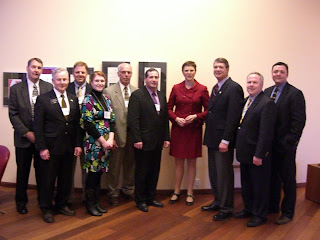


Susanne Juhl (pronounced Susannah Yool), Deputy Permanent Secretary for National Energy and Climate, gave our group an overview of Danish energy policy. Here the elected officials in our group pose for a photo with Miss Juhl. From left, Representative Phillip Meuller, Senator Jim Dotzenrod, Senator Terry Wanzek, Jamestown Mayor Katie Anderson, Representative Dennis Johnson, Agriculture Commissioner Doug Goehring, Miss Juhl, Attorney General Wayne Stenehjem, Senator Tim Flakoll, and Representative Craig Headland.

In her presentation, Miss Juhl made the statement that Denmark has "declared a state of energy independence."

My question to Americans, especially North Dakotans who read this: Can WE declare a state of energy independence as well, stop relying on foreign oil and start looking within our borders for the answers to our energy needs? I think we can.


I also think that some of the technologies I have seen these last few days may be part of the answer. Obviously, you can't just "copy and paste" what the Danish are doing and expect it to work in North Dakota, in a completely different political and economic system, but the question our group is trying to answer is "what pieces of the technology that the Danish have developed can be applied successfully in North Dakota"?


A few other fun facts about Danish energy policy:
- Denmark is the ONLY nation in the European Union that is a net energy exporter.
- There are 5,050 wind towers in Denmark.
- 17% of the energy generated from wind towers in Denmark is generated off shore (by wind towers in the ocean).
- The Danish utilize wind, straw, wood, biogas, waste (manure and food waste), and heat pumps as sources of energy.
- The Danish have set a goal of "fossil fuel independence" and have set forth to stop using oil by 2050.
- There currently is no tax on biomass because it is a fairly new source of energy. They will begin to tax biomass in 2020.


Here was my favorite part of today's tour: The fully automated crane that offloaded EIGHT large straw bales at a time (weighing MANY TONS) and stacked them on the conveyor system to be utilized in the power plant. Oh how I wish the baler/wagons I worked with as a kid had this feature :) I remember some really hot, muggy Maryland summers pulling small square bales out of the baler and stacking them on a flatbed wagon and then returning from the field and stacking them (again) in the barn . Built character...right? :)


Hope you enjoyed another virtual adventure in Denmark!
Sarah :)

Thursday, March 10, 2011

Inbicon Kalundborg Biomass Refinery Demonstration Plant

Kalundborg Biomass Refinery Demonstration Plant


Today in Denmark, on my journey to learn more about converting cellulosic biomass into high value products, we had presentations by the Inbicon CEO, Niels Henrikson, Inbicon staff Henrik Boye Jorgenson, and Danish Technological Institute staff Jorgen Hinge.

Here are a few key points:

Neils reviewed the history of DONG Energy's development of Inbicon and the Kalundborg demonstration plant. Their vision is to deliver renewable energy on a stable basis. Currently, DONG Energy produces energy from coal, wind, and oil drilling in the North Sea. Currently, they are making 80% of their energy from coal. In 2009, they utilized 11% biomass. Their goal is to utilize 60% biomass for combined heat and power production by 2020. DONG Energy is a major player in European energy production, employs 6,000 people and had $10 billion (U.S. dollars) in revenue in 2009.
Inbicon, a subsidiary of DONG Energy, desires to be a partner with other companies, providing the knowledge to help build energy plants around the world. In 2009 the Kalundborg plant opened.
ND Agriculture Commissioner Doug Goehring (standing, on right) presents a thank you gift to Neils Henrikson, CEO of Inbicon (standing, on left) for hosting our group.
Henrik Jorgenson (center, red coat) leads a tour through the plant. Also pictured are Rick Lancaster, Vice President of Great River Energy (on left), and Jim Boyd, representing the Jamestown/Stustman Development Corporation (on right).

Here's our group sporting our safety gear: Steel toed shoes, safety glasses and hard hats.
Click here to learn more about the Kalundborg Biomass Refinery Demonstration Plant

The basics:
Add wheat straw. (Wheat straw is the "stem" of the wheat plant). The actual bales are MUCH larger than this one! About 4 feet tall, 4 feet wide, and 8 feet long.
The straw is "pre-treated" by chopping and heating it, then enzymes are added which liquifies the fibers, then you ferment it with yeast, then you distill it, then you seperate it.
Three energy products result:
Bioethanol, which can be blended with gasoline to fuel your car!
...Solid biofuel (lignin), which can be used to replace coal in power and heat generation.
...and C5 Molasses, which can be used for energy production or animal feed. This smells SO delicious. It would be like candy to a cow!
Hope you enjoyed this virtual tour of the Kalundborg Biomass Refinery Demonstration Plant!
Sarah :)

Wednesday, March 9, 2011

Velkommen til Kobenhavn!

Velkommen til Kovenhavn! (Welcome to Copenhagen!)


Yesterday/today (it's all running together now) I travelled from Jamestown, North Dakota to Minneapolis, Minnesota (airport tram ride with MN Gov. Tim Pawlenty- cool!) to Amsterdam (capital of the Netherlands) to Copenhagan, Denmark. No real issues until we arrived and learned that there are not one, but SEVEN "Scandic Hotels" in Copenhagan. The first one we went to was NOT the one we needed to be at, so we investigated and then traveled 5 minutes to the correct hotel :)

Dropping off my bags in my tidy little room with the traditional clean lines of Danish design was SUCH a relief!


The view from my hotel room window:
My travelling companions at this point are Jim Boyd, representing the Jamestown/Stutsman Development Corporation (JSDC), Randy Neva, Jamestown-area farmer/rancher, and Jamestown Mayor, Katie Andersen.
Tomorrow we'll be joined by a host of others including local legislators, the ND Agriculture Commissioner, ND Attorney General, and representatives from Great River Energy, The Bank of North Dakota, Great Plains Institute, ND Dept. of Commerce, ND Corn Growers Association, ND Corn Utilization Council, and the ND Grain Growers Association. We'll total 22 when everyone arrives.
I was honored to be invited to be part of this delegation by the JSDC and am charged with the responsibility of representing the interests of our farm and other Jamestown area farmers. See http://www.growingjamestown.com/ for more information on the work of the JSDC.
So, WHY, you ask is our group in Denmark?
Great River Energy and Inbicon, the cellulosic biomass refinery technology subsidiary of the Danish utility company, DONG Energy, are working together to develop and build a cellulosic biomass refinery in North Dakota. The biomass refinery, Dakota Spirit Ag Energy (DSA) will be located in Spiritwood, North Dakota.
Eventually, the goal is to have DSA converting biomass (wheat straw and parts of corn plants other than corn grain called "corn stover") into a variety of energy products including ethanol, molasses, and lignin pellets. DSA would utilize approximately 480,000 tons/year of biomass.
Here in Denmark, Inbicon has a demonstration biomass facility in Kalundborn (about an hour and a half bus ride from Copenhagen).
We're going to take a gander at that plant tomorrow.
So will this work in North Dakota? The jury is still out. We've got a lot to analyze. What are the logistics? How will we grow and harvest the biomass crops and deliver them to the plant? What are the effects on soil health? Most importantly, will this be profitable for local farmers and other parties involved?
My list of questions to answer this week is long, but I'm excited to get learning tomorrow. Stay tuned!
One last note. I sat down with my fellow Jamestownians tonight and enjoyed a delicious supper of chicken cordon bleu. I was entertained by the fact that the menu at our hotel restaurant had a "CLIMATE" section. In this section, plant-based, organic, locally produced foods were proclaimed as superior to other foods, and the production of cod (fish) fillet was even compared to a liter of milk, based on it's carbon emission.
Oh boy, am I ever back in Europe. Don't get me wrong, I really love European farmers, but they are subjected to the whims of a public (and resulting legislators/legislation) that have bought into the "climate change" gimic hook, line, and sinker. (groan).
I happily and gratefully enjoyed my dinner that included pork and chicken and cheese (dairy), along with an array of fresh vegetables, and gave thanks for ALL farmers (not just the organic folks), including my family, who are working hard everyday to raise food using sustainable, environmentally-friendly methods.
Food for thought: If it weren't for the initiative of farmers and the agriculture industry to constantly pursue innovations in efficient and effective methods of feeding and fueling our world, I would be at home in North Dakota, content with the status quo, instead of doing research in Denmark.
THANKS for taking the time to visit my little place in cyberspace,
Sarah :)